Господь наделил человека фантазией и правом выбора. Одни люди голосуют за демократов, а другие — за республиканцев. Одни люди болеют за «Спартак» — а другие за «Динамо». Да что там. Одни люди считают, что окрошку надо готовить на квасе. А другие — что на кефире.
Вот и теперь. Еще несколько лет назад вся страна обсуждала возможность перехода на четырехдневную рабочую неделю. Да что там несколько лет назад! Несколько недель назад одна из профсоюзных организаций снова выступила на эту тему. Вот их слова, цитирую, «Сокращение нормальной продолжительности рабочей недели, позволяющей ввести четырехдневную рабочую неделю, будет способствовать повышению производительности труда за счёт высвободившегося свободного рабочего времени, позволяющего сохранить уровень здоровья и удовлетворять духовные потребности работника».
Понимаете? Я уже даже не говорю про то, что высвободившееся свободное время как-то поможет сохранить уровень здоровья. Тут тоже бывают очень разные мнения.
Но духовные потребности работника!
Впрочем, мы живем в мире, где у людей есть право выбора. И вот уже другая организация выступает за, внимание, увеличение рабочей недели до шести дней. Потому что время такое и нам нужен прорыв. Авторы предложения ссылаются на Иран и Непал, где шестидневная рабочая неделя уже вот прямо сейчас. Хотя, честно говоря, я совершенно не понимаю, что в Непале можно делать шесть дней в неделю.
Ну да бог с ним, с Непалом. У всех есть право выбора. Но вот что интересно. Те, которые за четырехдневную неделю всегда уточняют, что она возможна только при сохранении зарплаты. А те, которые за шестидневную про зарплату вообще ничего не говорят.
И ладно там деньги. Мы и без денег способны горы свернуть, если надо. Но как быть с духовными потребностями? Вот что русскому человеку гораздо нужнее, чем деньги. И предлагающие работать дольше ничего про эти потребности не говорят.
Так что судьба инициативы кажется мне печальной. Заранее обреченной на провал.
Однако и на четыре дня никто не будет переходить. Потому что как это — платить человеку столько же за то, что он работает меньше?
Johnny Cash's Hurt hits way different in A Major, as much so as Ring of Firein G Minor. The dissonance in tone between the chords is, ahem, a minor one: simply the third note lowered to a flat. But that change can fundamentally alter how a song sounds, and what feelings that song conveys. In their new book Every Brain Needs Music: The Neuroscience of Making and Listening to Music, Dr. Larry S Sherman, professor of neuroscience at the Oregon Health and Science University, and Dr. Dennis Plies, a music professor at Warner Pacific University, explore the fascinating interplay between our brains, our instruments, our audiences, and the music they make together.
The Minor Fall and The Major Lift: Sorting Out Minor and Major Chords
Another function within areas of the secondary auditory cortex involves how we perceive different chords. For example, part of the auditory cortex (the superior temporal sulcus) appears to help distinguish major from minor chords.
Remarkably, from there, major and minor chords are processed by different areas of the brain outside the auditory cortex, where they are assigned emotional meaning. For example, in Western music, minor keys are perceived as “serious” or “sad” and major keys are perceived as “bright” or “happy.” This is a remarkable response when you think about it: two or three notes played together for a brief period of time, without any other music, can make us think “that is a sad sound” or “that is a happy sound.” People around the world have this response, although the tones that illicit these emotions differ from one culture to another. In a study of how the brain reacts to consonant chords (notes that sound “good” together, like middle C and the E and G above middle C, as in the opening chord of Billy Joel’s “Piano Man”), subjects were played consonant or dissonant chords (notes that sound “bad”together) in the minor and major keys, and their brains were analyzed using a method called positron emission tomography (PET). This method of measuring brain activity is different from the fMRI studies we discussed earlier. PET scanning, like fMRI, can be used to monitor blood flow in the brain as a measure of brain activity, but it uses tracer molecules that are injected into the subjects’ bloodstreams. Although the approach is different, many of the caveats we mentioned for fMRI studies also apply to PET studies. Nonetheless, these authors reported that minor chords activated an area of the brain involved in reward and emotion processing (the right striatum), while major chords induced significant activity in an area important for integrating and making sense of sensory information from various parts of the brain (the left middle temporal gyrus). These findings suggest the locations of pathways in the brain that contribute to a sense of happiness or sadness in response to certain stimuli, like music.
Don't Worry, Be Happy (or Sad): How Composers Manipulate our Emotions
Although major and minor chords by themselves can elicit “happy” or “sad” emotions, our emotional response to music that combines major and minor chords with certain tempos, lyrics, and melodies is more complex. For example, the emotional link to simple chords can have a significant and dynamic impact on the sentiments in lyrics. In some of his talks on the neuroscience of music, Larry, working with singer, pianist, and songwriter Naomi LaViolette, demonstrates this point using Leonard Cohen’s widely known and beloved song “Hallelujah.” Larry introduces the song as an example of how music can influence the meaning of lyrics, and then he plays an upbeat ragtime, with mostly major chords, while Naomi sings Cohen’s lyrics. The audience laughs, but it also finds that the lyrics have far less emotional impact than when sung to the original slow-paced music with several minor chords.
Songwriters take advantage of this effect all the time to highlight their lyrics’ emotional meaning. A study of guitar tablatures (a form of writing down music for guitar) examined the relationship between major and minor chords paired with lyrics and what is called emotional valence: In psychology, emotions considered to have a negative valence include anger and fear, while emotions with positive valence include joy. The study found that major chords are associated with higher-valence lyrics, which is consistent with previous studies showing that major chords evoke more positive emotional responses than minor chords. Thus, in Western music, pairing sad words or phrases with minor chords, and happy words or phrases with major chords, is an effective way to manipulate an audience’s feelings. Doing the opposite can, at the very least, muddle the meaning of the words but can also bring complexity and beauty to the message in the music.
Manipulative composers appear to have been around for a long time. Music was an important part of ancient Greek culture. Although today we read works such as Homer’s Iliad and Odyssey, these texts were meant to be sung with instrumental accompaniment. Surviving texts from many works include detailed information about the notes, scales, effects, and instruments to be used, and the meter of each piece can be deduced from the poetry (for example, the dactylic hexameter of Homer and other epic poetry). Armand D’Angour, a professor of classics at Oxford University, has recently recreated the sounds of ancient Greek music using original texts, music notation, and replicated instruments such as the aulos, which consists of two double-reed pipes played simultaneously by a single performer. Professor D’Angour has organized concerts based on some of these texts, reviving music that has not been heard for over 2,500 years. His work reveals that the music then, like now, uses major and minor tones and changes in meter to highlight the lyrics’ emotional intent. Simple changes in tones elicited emotional responses in the brains of ancient Greeks just as they do today, indicating that our recognition of the emotional value of these tones has been part of how our brains respond to music deep into antiquity.
This article originally appeared on Engadget at https://www.engadget.com/hitting-the-books-every-brain-needs-music-sherman-piles-columbia-university-press-143039604.html?src=rss
Взято отсюда
Earlier today, OpenAI released the official ChatGPT app for iPhone. The tool has become well known for answering users’ requests and solving from the simplest to the most complex issues thanks to artificial intelligence.
Apple
, however, doesn’t want its employees using such tools. In an internal memo, the company said that generative AIs can’t be used for work.
Футурологи пугают человечество предсказаниями засилия искусственного интеллекта. Да что там футурологи — уже даже политики предлагают вводить специальные налоги на использование роботов на производстве.
Причем тема эта не новая. Уже лет двадцать назад эксперты констатировали, что доля спама в коммуникации по электронной почте превысила долю сообщений живых людей. Да вы и сами это знаете, когда заходите в свой почтовый ящик и видите там десятки сообщений, которые вам не нужны.
И вот теперь выясняется, что почти половина всей активности в интернете приходится на ботов. Ну то есть не в электронной почте и не в массовых рассылках. А именно что в социальных сетях.
Понимаете? С вероятностью в 50 процентов вы не знаете, с кем вы разговариваете в своих социальных сетях. С живым человеком или с роботом.
И нет никаких оснований полагать, что эта тенденция не будет расти. Тем более, что за последние пару лет искусственный интеллект достиг таких высот в развитии, что скоро все забудут про Алана Тьюринга и его тест. Он больше не актуален.
А вот что будет дальше — это очень интересно. И Алан Тьюринг нам в осознании этого будущего уже не поможет. Потому что он умер.
И вполне вероятно, что однажды мы проснемся в мире, где в виртуальном пространстве больше вообще не будет людей. А будут одни роботы.
И как только люди осознают это и поймут, что с роботами не так интересно — они выйдут из виртуальности и вернутся в реальность. Выйдут на улицу, познакомятся с девушкой. Ну или девушка познакомится с парнем. И они в знак своей любви повесят свои телефоны на каком-нибудь мосту вместо замка.
И мир вернется на круги своя. А весь этот морок развеется. Люди станут разговаривать голосом, а не через текстовые сообщения. И ночью они станут быть вместе, а не с экраном. Где вроде как всё то же самое, но всё же не совсем то же самое.
Интересно, хоть кто-нибудь из вас, слушающих сейчас эту реплику, в это поверил?
Разумеется, всё останется так, как оно есть. Разве что людям придется прорываться через толпы галдящих ботов, чтобы докричаться друг до друга.
А интернет-компаниям придется увеличивать и увеличивать свои мощности. С тем, чтобы всем хватило места в виртуальном пространстве.
И еще наверняка появится профессия юриста, защищающего права ботов.
With a rising mortality rate combining with slowing gain in life expectancy and a dramatic drop in fertility, the population of the Faroe Islands could be headed for decline after decades of growth.
At the beginning of this century, the average fertility rate for Faroese women of childbearing age was 2.5, however for the past couple of years that rate has dropped significantly, according to Statistics Faroe Islands. Whereas in 2019 the fertility rate was 2.4, by 2020 and 2021 it had dropped to 2.3, only to plunge to 2.05 in 2022—well below the 2.1 mark, at which the generation of women of childbearing age can no longer replace itself.
In other words, a recipe for overall population decline, notwithstanding the fact that the fertility rate in the island nation remains the highest in Europe, as per Eurostat.
The total population of the Faroe Islands had reached 54,362 at the beginning of April this year, a 1.1-percent increase year-on-year, yet again a lower increase compared to the previous year.
The past year’s population growth is due to a natural increase of 187 and a net migration of 382, according to Statistics Faroe Islands, with fewer people having deceased during this period compared to the previous 12-month period.
The death rate, meanwhile, which for the past many years has been fairly steady, was unusually high in the first half of 2022, we’re told, while at the same time the birth rate was also dramatically declining.
The net migration during these past 12 months had reportedly dropped year-on-year, with growing numbers of people leaving the country.
In related news, according to the latest figures from Statistics Faroe Islands, the average life expectancy for Faroese women is 85.4 years, compared to 81.3 for men.
Since the mid 1980s, the average life expectancy has increased by 6.6 years for women and 9.4 years for men. Back then the difference between women and men in this regards was seven years, which means that gap has been closing in recent years.
Compared to other countries in Europe, the average life expectancy in the Faroe Islands is on the higher end, with San Marino topping the life expactancy list at 86.5 years, followed by Lichtenstein, Spain, Switzerland, France and the Faroe Islands. For men, Lichtenstein is reporting the highest life expectancy at 82.5 years, followed by Iceland, Switzerland, Norway and the Faroes.
Есть такое существо в рунете под названием ALEXANDR_ROGERS, любящий учить мир жить. Особенно он не любит Америку, в которой он, похоже, никогда не был и знания о коей он подчерпывает то ли из ленты.ру, то ли из бредней Хазина.
Вот его последний петушачий крик: ... российские либералы-западники, и украинские русофобы годами назойливо повторяли «У одной Калифорнии ВВП больше, чем у всей Российской Федерации». Типа «Ну против кого вы вообще рыпаетесь?». Мы рыпаемся против страны, треть которой в руинах (как Детройт), вторая треть в бездомных (как та же Калифорния), а оставшаяся часть в наркоманах. И вся целиком она погрязла в перестрелках и массшутингах. Впрочем, в долгах она погрязла ещё больше…
Это чудо даже не рефлексирует, что пользуется американским интернетом,американскими компьютерами, американскими мобильными телефонами, американской навигацией, американскими поисковыми системами, американскими языками программирования, американскими автомобилями, американскими самолетами, смотрит американское кино, не сам, так сосед, носит американские джинсы и американские сникерсы - пусть и китайского производства, но американские, говорит на смеси американского с нижегородским: Байтить, Буллинг, Вайб, Войсить, Задонатить, Кринж, Изи, Краш, Криповый - это молодежный язык...
Собственно, 90% того, что окружает это чудо и вообще любого человека в мире сегодня, за исключение "вышиванок" на Украине... и даже не знаю чего - не могу сообразить, - в России. Ах, да... "Гиперзвук". Который правда, не гиперзвук в общепринятом понимании, но все же.
Но это бог с ним. Но в России тов. Роджерса, как всех малограмотных российских экономистов ничего не понимающих с том, как работает американская экономика крайне радует перспектива американского дефолта и, особенно, увеличение порога федерального долга.
Начну с возврата в 2011 год. Цитата: В минувшее воскресенье 24 июля Белый Дом и Конгресс США так и не сумели договориться по вопросам внешнего долга и дефицита бюджета. По сей день остается неясным план, согласно которому власти США собираются преодолеть финансовые барьеры... есть вероятность возникновения «технического дефолта», чего так не хочет президент Барак Обама.
Нет, пожалуй, в начало 60-х годов. Американский экономист Роберт Триффин указал на (кажущееся) противоречие, которое возникает, если для международных расчётов и национальных валютных резервов используется валюта только одного государства. Он писал: Для того, чтобы обеспечить центральные банки других стран необходимым количеством долларов для формирования национальных валютных резервов, необходимо, чтобы в США постоянно наблюдался дефицит платёжного баланса. Но дефицит платёжного баланса подрывает доверие к доллару и снижает его ценность в качестве резервного актива, поэтому для укрепления доверия требуется профицит платёжного баланса.
Так что, можно сказать Хазин и Роджерс "проснулись". Так вот, почему указанное Триффином противоречие кажущееся, а Роджерс и иже с ним несут голимый бред без какого-либо понимания экономики и финансов?
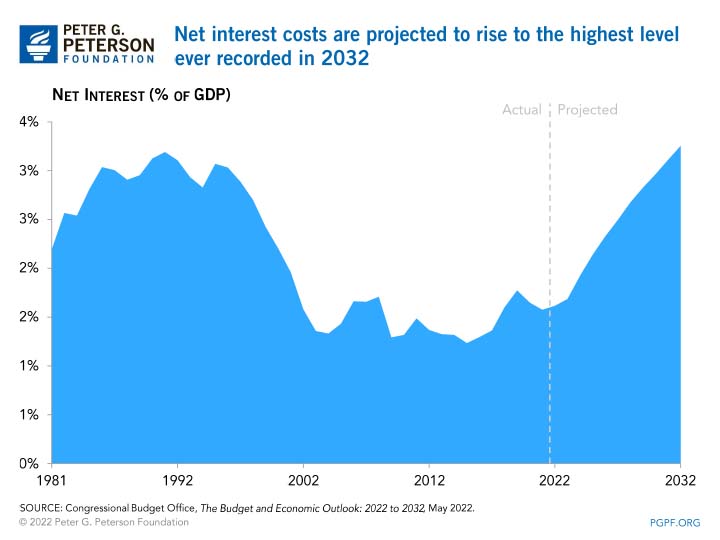
Посмотрим на первую картинку:
Это процент ВВП, который США должны тратить на обслуживание национального долга, причем с прогнозом до 2033 года. Сегодя , в 2023 году это 1.9%, а в физическом выражении это 475 миллиардов долларов.
Первый вопрос: что такое "национальный долг"? - Этот долг состоит из двух главных частей - частных долгов публики и собственно государственного долга. Собственно государственный долг возникает для покрытия разницы между доходами и расходами.
Механизм "взятия в долг" - это продажа государством тежуриз разного вида, облигаций, некоторых видов секьюритиз - например, инфляционно защищенных бумаг, и т.д. Все эти инструменты имеют срочный характер. То есть, продав сегодя, выплаты по ним государство должно делать спустя некоторое время. Но держатели этих бумаг могут получить прибыль быстрее, продав их кому-то еще по рыночной на момент продажи цене.
Сегодня США платят, например, (bond yield) 3.463% годовых по 10-летним облигациям, и 3.783% по 30-летним. Много это или мало?
Уже все, кажется, за рыночные времена, что деньги со временем дешевеют в силу инфляции. Поскольку трежуриз продаются "в мир", то bond yield нужно сравнивать с мировой инфляцией. Сегодня мировая инфляция составляет... 8.75% (!). Что это значит? - Это значит, что когда придет время покрывать долг, США купят нужную сумму, более дешевыми деньгами, чем они брали в долг ! То есть, в реальности США на долге зарабатывают чисто финансово и ничем страшным для них увеличение долга не грозит.
Единственное, что ограничивает США в смысле увеличения долга: это ограниченная возможность переварить взятые в долг деньги.
Это как если бы заняли деньги, которые не в состоянии потратить (!).
Но и это еще не все. Есть еще одно ключевое непонимания людей типа Роджерса и Хазина. Они просто не понимают. почему расходы могут превышать доходы? - Хотя любому нормальному экономисту понятно, что расходы - это не не просто расходы, системы "пропил". Это ИНВЕСТИЦИИ, которые приносят деньги, в том числе, и государству, хотя и косвенно, через налоги, через рабочие места и т.д.
С чем связана сегодняшняя инфляции в США? - Исключительно с выходом из ковидной ситуации. За два ковидные года Правительство США сделало колоссальные выплаты не только людям для поддержки штанов, но и вставшим компаниям. При этом производство не увеличилось и даже сократилось. Отсюда - инфляция. Но выход из инфляции (а он осуществляется успешно - уже в а преле годовая инфляция упала ниже 5% и, к концу года скорее всего вернется к многолетнему уровню.
А что же с бюджетными спорами и мрачными прогнозами некоторых экономистов? Тут все просто: это простая более или менее имитационная предвыборная борьба между республиканцами и демократами. В хоте этой борьбы республиканцы стремятся сократить или закрыть популистские демократические программы, которые те могут ис пользовать как козыри.
Ничего страшного. Я не случайно отправил вас сперва в 2011 год. Это - стандартная ситуация. Тогда даже правительство несколько месяцев работало бесплатно, так как бюджет не был утвержден. И мир не рухнуд. И США тоже.
Ну а насчет "ржавого пояса", наркомании и стрельбы - как-нибудь потом. Там тоже нет проблем. Кстати об убийствах. Количество убийств на 100000 населения в США - 5.3, в России 9.2.... Но это к слову.
Взято отсюда
Google’s still careful to say SGE is an experiment — but it’s a front-and-center one now. | Image: Google
Google is moving slowly and carefully to make AI happen. Maybe too slowly and too carefully for some people. But if you opt in, a whole new search experience awaits.
The future of Google Search is AI. But not in the way you think. The company synonymous with web search isn’t all in on chatbots (even though it’s building one, called Bard), and it’s not redesigning its homepage to look more like a ChatGPT-style messaging system. Instead, Google is putting AI front and center in the most valuable real estate on the internet: its existing search results.
To demonstrate, Liz Reid, Google’s VP of Search, flips open her laptop and starts typing into the Google search box. “Why is sourdough bread still so popular?” she writes and hits enter. Google’s normal search results load almost immediately. Above them, a rectangular orange section pulses and glows and shows the phrase “Generative AI is experimental.” A few seconds later, the glowing is replaced by an AI-generated summary: a few paragraphs detailing how good sourdough tastes, the upsides of its prebiotic abilities, and more. To the right, there are three links to sites with information that Reid says “corroborates” what’s in the summary.
Google calls this the “AI snapshot.” All of it is by Google’s large language models, all of it sourced from the open web. Reid then mouses up to the top right of the box and clicks an icon Google’s designers call “the bear claw,” which looks like a hamburger menu with a vertical line to the left. The bear claw opens a new view: the AI snapshot is now split sentence by sentence, with links underneath to the sources of the information for that specific sentence. This, Reid points out again, is corroboration. And she says it’s key to the way Google’s AI implementation is different. “We want [the LLM], when it says something, to tell us as part of its goal: what are some sources to read more about that?”
A few seconds later, Reid clicks back and starts another search. This time, she searches for the best Bluetooth speakers for the beach. Again, standard search results appear almost immediately, and again, AI results are generated a few seconds later. This time, there’s a short summary at the top detailing what you should care about in such a speaker: battery life, water resistance, sound quality. Links to three buying guides sit off to the right, and below are shopping links for a half-dozen good options, each with an AI-generated summary next to it. I ask Reid to follow up with the phrase “under $100,” and she does so. The snapshot regenerates with new summaries and new picks.
Image: Google
These AI snapshots will appear at the top of Search and pull information from all over the web.
This is the new look of Google’s search results page. It’s AI-first, it’s colorful, and it’s nothing like you’re used to. It’s powered by some of Google’s most advanced LLM work to date, including a new general-purpose model called PaLM2 and the Multitask Unified Model (MuM) that Google uses to understand multiple types of media. In the demos I saw, it’s often extremely impressive. And it changes the way you’ll experience search, especially on mobile, where that AI snapshot often eats up the entire first page of your results.
There are some caveats: to get access to these AI snapshots, you’ll have to opt in to a new feature called Search Generative Experience (SGE for short), part of an also-new feature called Search Labs. Not all searches will spark an AI answer — the AI only appears when Google’s algorithms think it’s more useful than standard results, and sensitive subjects like health and finances are currently set to avoid AI interference altogether. But in my brief demos and testing, it showed up whether I searched for chocolate chip cookies, Adele, nearby coffee shops, or the best movies of 2022. AI may not be killing the 10 blue links, but it’s definitely pushing them down the page.
SGE, Google executives tell me over and over, is an experiment. But they’re also clear that they see it as a foundational long-term change to the way people search. AI adds another layer of input, helping you ask better and richer questions. And it adds another layer of output, designed to both answer your questions and guide you to new ones.
An opt-in box at the top of search results might sound like a small move from Google compared to Microsoft’s AI-first Bing redesign or the total newness of ChatGPT. But SGE amounts to the first step in a complete rethinking of how billions of people find information online — and how Google makes money. As pixels on the internet go, these are as consequential as it gets.
Image: Google
The AI snapshots borrow colors from the content they discover and change depending on what you search.
Asked and answered
Google feels pretty good about the state of its search results. We’re long past the “10 blue links” era of 25 years ago when you Googled by typing in a box and getting links in return. Now you can search by asking questions aloud or snapping a picture of the world, and you might get back everything from images to podcasts to TikToks.
Many searches are already well-served by these results. If you’re going to Google and searching “Facebook” to land on facebook.com or you’re looking for the height of the Empire State Building, you’re already good to go.
But there’s a set of queries for which Google has never quite worked, which is where the company is hoping AI can come in. Queries like “Where should I go in Paris next week?” or “What’s the best restaurant in Tokyo?” These are hard questions to answer because they’re not actually one question. What’s your budget? What days are all the museums open in Paris? How long are you willing to wait? Do you have kids with you? On and on and on.
“The bottleneck turns out to be what I call ‘the orchestration of structure,’” says Prabhakar Raghavan, the SVP at Google who oversees Search. Much of that data exists somewhere on the internet or even within Google — museums post hours on Google Maps, people leave reviews about wait times at restaurants — but putting it all together into something like a coherent answer is really hard. “People want to say, ‘plan me a seven-day vacation,” Raghavan says, “and they believe if the language model outputs, it should be right.”
One way to think about these is simply as questions with no right answer. A huge percentage of people who come to Google aren’t looking for a piece of information that exists somewhere. They’re looking for ideas, looking to explore. And since there’s also likely no page on the internet titled “Best vacation in Paris for a family with two kids, one of whom has peanut allergies and the other loves soccer, and you definitely want to go to the Louvre on the quietest possible day of the week,” the links and podcasts and TikToks won’t be much help.
Because they’re trained on a huge corpus of data from all over the internet, large language models can help answer those questions by essentially running lots of disparate searches at once and then combining that information into a few sentences and a few links. “Lots of times you have to take a single question and break it into 15 questions” to get useful information from search, Reid says. “Can you just ask one? How do we change how the information is organized?”
That’s the idea, but Raghavan and Reid are both quick to point out that SGE still can’t do these completely creative acts very well. Right now, it’s going to be much more handy for synthesizing all the search data behind questions like “what speaker should I buy to take into the pool.” It’ll do well with “what were the best movies of 2022,” too, because it has some objective Rotten Tomatoes-style data to pull from along with the internet’s many rankings and blog posts on the subject. AI appears to make Google a better information-retrieval machine, even if it’s not quite ready to be your travel agent.
One thing that didn’t show up in most SGE demos? Ads. Google is still experimenting with how to put ads into the AI snapshots, though rest assured, they’re coming. Google’s going to need to monetize the heck out of AI for any of this to stick.
Image: Google
Right now, AI hasn’t really changed how Google ads work. But it will.
The Google Bot
At one point in our demo, I asked Reid to search only the word “Adele.” The AI snapshot contained more or less what you’d expect — some information about her past, her accolades as a singer, a note about her recent weight loss — and then threw in that “her live performances are even better than her recorded albums.” Google’s AI has opinions! Reid quickly clicked the bear claw and sourced that sentence to a music blog but also acknowledged that this was something of a system failure.
Google’s search AI is not supposed to have opinions. It’s not supposed to use the word “I” when it answers questions. Unlike Bing’s multiple-personality chaos or ChatGPT’s chipper helper or even Bard’s whole “droll middle school teacher” vibe, Google’s search AI is not trying to seem human or affable. It’s actually trying very hard to not be those things. “You want the librarian to really understand you,” Reid says. “But most of the time, when you go to the library, your goal is for them to help you with something, not to be your friend.” That’s the vibe Google is going for.
The reason for this goes beyond just that strange itchy feeling you get talking to a chatbot for too long. And it doesn’t seem like Google is just trying to avoid super horny AI responses, either. It’s more a recognition of the moment we’re in: large language models are suddenly everywhere, they’re far more useful than most people would have guessed, and yet they have a worrying tendency to be confidently wrong about just about everything. When that confidence comes in perfectly formed paragraphs that sound good and make sense, people are going to believe the wrong stuff.
A few executives I spoke to mentioned a tension in AI between “factual” and “fluid.” You can build a system that is factual, which is to say it offers you lots of good and grounded information. Or you can build a system that is fluid, feeling totally seamless and human. Maybe someday you’ll be able to have both. But right now, the two are at odds, and Google is trying hard to lean in the direction of factual. The way the company sees it, it’s better to be right than interesting.
Google projects a lot of confidence in its ability to be factually strong, but recent history seems to suggest otherwise. Not only is Bard less wacky and fun than ChatGPT or Bing, but it’s also often less correct — it makes basic mistakes in math, information retrieval, and more. The PaLM2 model should improve some of that, but Google certainly hasn’t solved the “AI lies” problem by a long shot.
There’s also the question of when AI should appear at all. Sometimes it’s obvious: the snapshots shouldn’t appear if you ask sensitive medical questions, Reid says, or if you’re looking to do something illegal or harmful. But there’s a wide swath of searches where AI may or may not be useful. If I search “Adele,” some basic summary information at the top helps; if I search “Adele music videos,” I’m much more likely to just want the YouTube videos in the results.
Google can afford to be cautious here, Reid says, because the fail state is just Google search. So whenever the snapshot shouldn’t appear, or whenever the model’s confidence score is low enough that it might not be more useful than the top few results, it’s easy to just not do anything.
Bold and responsible
Compared to the splashy launch of the new Bing or the breakneck developmental pace of ChatGPT, SGE feels awfully conservative. It’s an opt-in, personality-free tool that collates and summarizes your search results. For Google, suddenly in an existential crisis over the fact that AI is changing the way people interact with technology, is that enough?
A couple of executives used the same phrase to describe the company’s approach: “bold and responsible.” Google knows it has to move fast — not only are chatbots booming in popularity, but TikTok and other platforms are stealing some of the more exploratory search out from under Google. But it also has to avoid making mistakes, giving people bad information, or creating new problems for users. To do that would be a PR disaster for Google, it would be yet more reason for people to try new products, and it would potentially destroy the business that made Google a trillion-dollar company.
So, for now, SGE remains opt-in and personality-free. Raghavan says he’s comfortable playing a longer game: “knee-jerk reacting to some trend is not necessarily going to be the way to go.” He’s also convinced that AI is not some panacea that changes everything, that 10 years from now, we’ll all do everything through chatbots and LLMs. “I think it’s going to be one more step,” he says. “It’s not like, ‘Okay, the old world went away. And we’re in a whole new world.’”
In other words, Google Bard is not the future of Google search. But AI is. Over time, SGE will start to come out of the labs and into search results for billions of users, mingling generated information with links out to the web. It will change Google’s business and probably upend parts of how the web works. If Google gets it right, it will trade 10 blue links for all the knowledge on the internet, all in one place. And hopefully telling the truth.
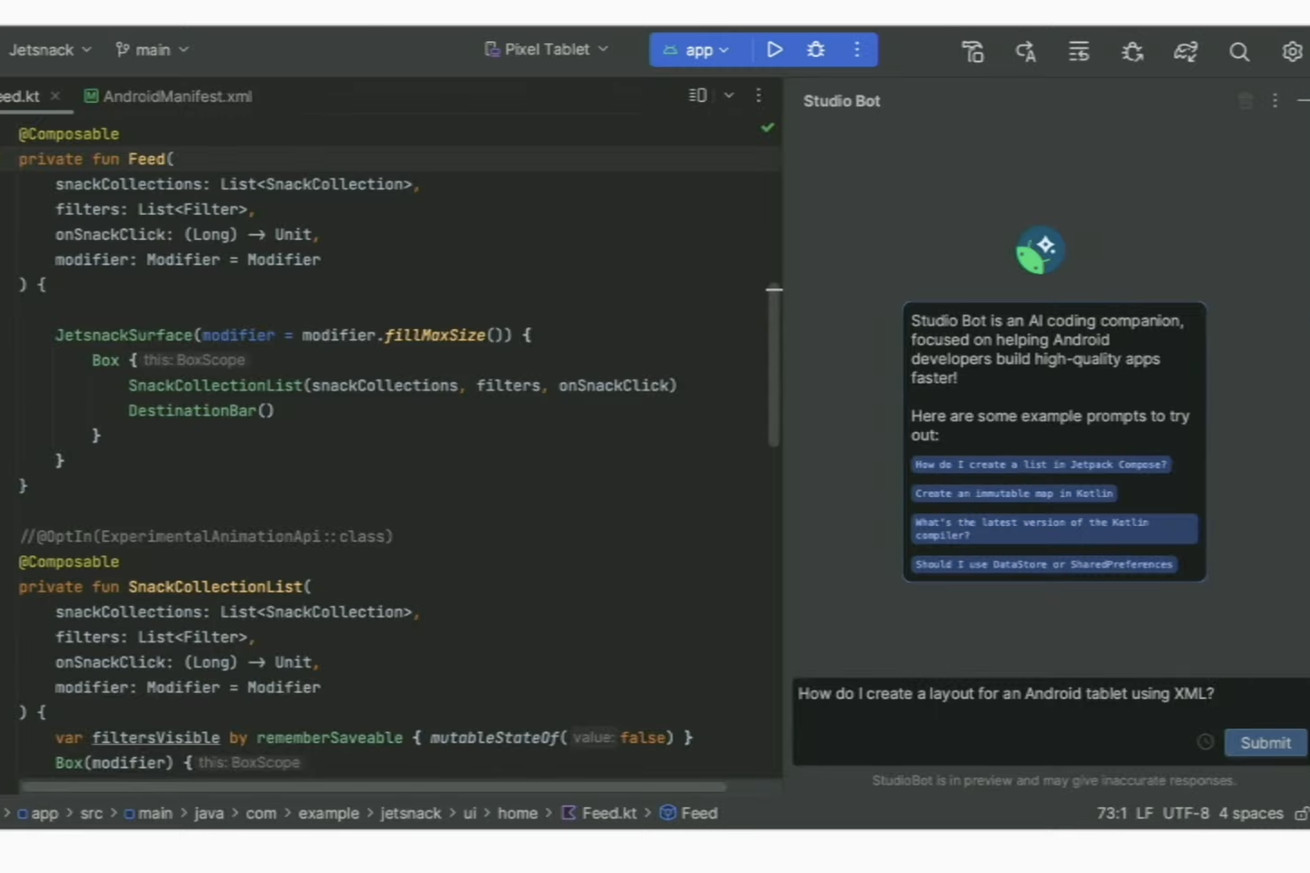
Google is launching a new AI-powered coding bot for Android developers. During its I/O event on Wednesday, Google announced that the tool, called Studio Bot, will help developers build apps by generating code, fixing errors, and answering questions about Android.
According to Google, the bot is built on Codey, the company’s new foundational coding model that stems from its updated PaLM 2 large language model (LLM). Studio Bot supports both the Kotlin and Java programming languages and will live directly in the toolbar on Android Studio. There, developers can get quick answers to their questions or even have the bot debug a portion of their code.
Screenshot: Emma Roth / The Verge
While Google notes that developers don’t need to share their source code with Google in order to use Studio Bot, the company will receive data on the conversations they have with the tool. Google says the bot is still in “very early days” but that it will continue training it to improve its answers. It’s also currently only available to developers in the US for now via the Canary channel, and there’s no word on when it will see a global launch.
The new AI-powered coding tool comes as part of Google’s continued push into AI. After making its Bard chatbot available in early access in March, Google has been gradually adding new features, including the ability to generate, debug, and explain lines of code. Packaging these features in a standalone coding assistant pits Google against Microsoft and Amazon, both of which have AI-powered coding tools of their own that developers can integrate into a variety of integrated development environments (IDE).
More AI-generated music mimicking a famous artist has made the rounds — while making lots of money for the scammer passing it off as genuine. A collection of fake Frank Ocean songs sold for a reported $13,000 CAD ($9,722 in US dollars) last month on a music-leaking forum devoted to the Grammy-winning singer, according toVice. If the story sounds familiar, it’s essentially a recycling of last month’s AI Drake / The Weeknd fiasco.
As generative AI takes the world by storm — Google just devoted most of its I/O 2023 keynote to it — people eager to make a quick buck through unscrupulous means are seizing the moment before copyright laws catch up. It’s also caused headaches for Spotify, which recently pulled not just Fake Drake but tens of thousands of other AI-generated tracks after receiving complaints from Universal Music.
The scammer, who used the handle mourningassasin, told Vice they hired someone to make “around nine” Ocean songs using “very high-quality vocal snippets” of the Thinkin Bout You singer’s voice. The user posted a clip from one of the fake tracks to a leaked-music forum and claims to have quickly convinced its users of its authenticity. “Instantly, I noticed everyone started to believe it,” mourningassasin said. The fact that Ocean hasn’t released a new album since 2016 and recently teased an upcoming follow-up to Blond may have added to the eagerness to believe the songs were real.
The scammer claims multiple people expressed interest in private messages, offering to “pay big money for it.” They reportedly fetched $3,000 to $4,000 for each song in mid to late April. The user has since been banned from the leaked-music forum, which may be having an existential crisis as AI-generated music makes it easier than ever to produce convincing knockoffs. “This situation has put a major dent in our server’s credibility, and will result in distrust from any new and unverified seller throughout these communities,” said the owner of a Discord server where the fake tracks gained traction.
This article originally appeared on Engadget at https://www.engadget.com/scammers-used-ai-generated-frank-ocean-songs-to-steal-thousands-of-dollars-222042845.html?src=rss
Взято отсюда
Stack Overflow, a question-and-answer portal for developers, would lay off 10% of its workforce, the company announced on Thursday.
The job cuts, which will affect at least 58 employees, are a result of the company’s renewed focus on profitability due to macroeconomic concerns, CEO Prashanth Chandrasekar said in a blog post.
“Our focus for this fiscal year is on profitability and that, along with macroeconomic pressures, led to today’s changes. They were also the result of taking a hard look at our strategic priorities for this fiscal year as well as our organizational structure as we invest in the continued growth of Stack Overflow for Teams and pursue agility and flexibility,” Chandrasekar said.
has reportedly pulled tens of thousands of tracks from generative AI company Boomy. It's said to have removed seven percent of the songs created by the startup's systems, which underscores the swift proliferation of AI-generated content on music streaming platforms.
Universal Music reportedly told Spotify and other major services that it detected suspicious streaming activity on Boomy's songs. In other words, there were suspicions that bots were being used to boost listener figures and generate ill-gotten revenue for uploaders. Spotify pays royalties to artists and rights holders on a per-listen basis.
“Artificial streaming is a longstanding, industry-wide issue that Spotify is working to stamp out across our service,” Spotify, which confirmed that it had taken down some Boomy tracks, told Insider. "When we identify or are alerted to potential cases of stream manipulation, we mitigate their impact by taking action that may include the removal of streaming numbers and the withholding of royalties. This allows us to protect royalty payouts for honest, hardworking artists."
Universal Music's chief digital officer Michael Nash told the Financial Times, which first reported on Spotify removing Boomy's tracks, that his company is "always encouraged when we see our partners exercise vigilance around the monitoring or activity on their platforms."
AI-generated music hit the headlines last month after a song that appeared to include vocals from Drake and The Weeknd went viral. Universal Music Group, which represents both artists, claimed that using the duo's voices to train generative AI systems constituted “a breach of our agreements and a violation of copyright law." Both Spotify and Apple Music removed the song from their libraries.
Music industry figures have been sounding the alarm bells about the overarching impact of AI-generated tracks, as well as people using bots to drive up listener figures and siphon money out of the kitties that streaming services use to pay royalties.
Boomy, which opened its doors in 2021, enables people to generate songs based on text inputs. Over the weekend, the company said that "curated delivery to Spotify of new releases by Boomy artists has been re-enabled."
Boomy says its users "have created 14,554,448 songs" or just under 14 percent of "the world's recorded music." Its website states that users can create original songs in seconds, then upload them "to streaming platforms and get paid when people listen."
This article originally appeared on Engadget at https://www.engadget.com/spotify-has-reportedly-removed-tens-of-thousands-of-ai-generated-songs-154144262.html?src=rss
Взято отсюда
Apple TV+ renewed its sci-fi show Severance for a second season last year, even before the season finale of the first season aired. However, the show had been facing “backstage drama,” according to a recent report, and now things have gotten worse. Amid the ongoing writers’ strike, the production of Severance’s second season has been completely suspended in New York.
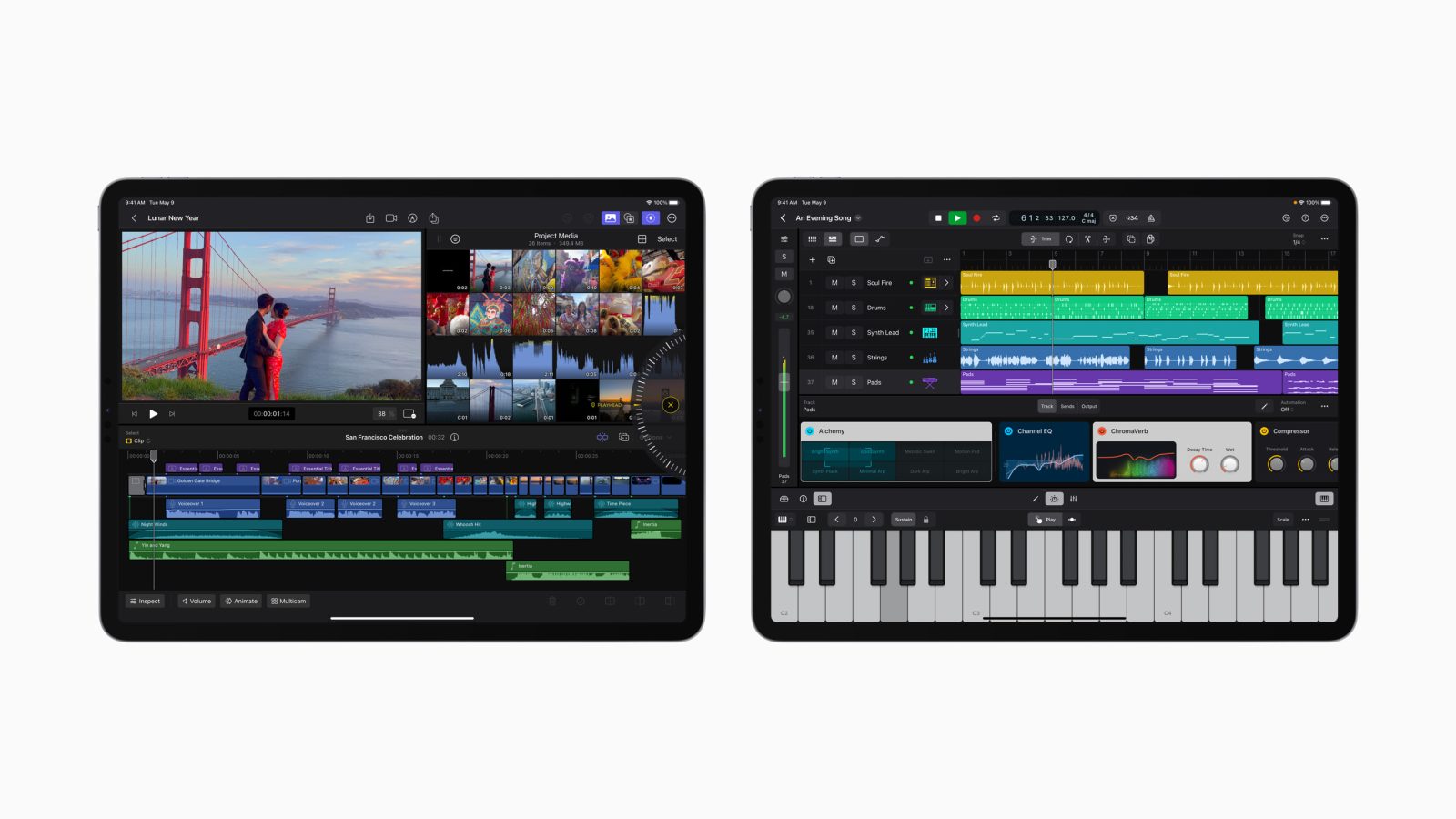
are officially and finally coming to iPad. Final Cut Pro is Apple’s professional video editing software that has been exclusive to Mac before now. The same is true for Logic Pro, Apple’s professional audio editing software for Mac. Both apps will land on the iPad later this month.
Last year, the EU passed legislation that will require the iPhone and many other devices with wired charging to be equipped with a USB-C port in order to be sold in the region.
Apple
has until December 28, 2024 to adhere to the law, but the switch from Lightning to USB-C is expected to happen with iPhone 15 models later this year.
It was rumored in February that Apple may be planning to limit charging speeds and other functionality of USB-C cables that are not certified under its "Made for iPhone" program. Like the Lightning port on existing iPhones, a small chip inside the USB-C port on iPhone 15 models would confirm the authenticity of the USB-C cable connected.
"I believe Apple will optimize the fast charging performance of MFi-certified chargers for the iPhone 15," Apple analyst Ming-Chi Kuo said in March.
In response to this rumor, European Commissioner Thierry Breton has sent Apple a letter warning the company that limiting the functionality of USB-C cables would not be permitted and would prevent iPhones from being sold in the EU when the law goes into effect, according to German newspaper Die Zeit. The letter was obtained by German press agency DPA, and the report says the EU also warned Apple during a meeting in mid-March.
Given that it has until the end of 2024 to adhere to the law, Apple could still move forward with including an authentication chip in the USB-C port on iPhone 15 models later this year. And with iPhone 16 models expected to launch in September 2024, even those devices would be on the market before the law goes into effect.
The report says the EU intends to publish a guide to ensure a "uniform interpretation" of the legislation by the third quarter of this year.
It is worth emphasizing that Apple potentially limiting the functionality of uncertified USB-C cables connected to iPhone 15 models is only a rumor for now, so it remains to be seen whether or not the company actually moves forward with the alleged plans. iPads with USB-C ports do not have an authentication chip for this purpose.
Разговор о красных линиях мне остро напоминает анекдот про Леонида Ильича, который, вернувшись из Индии попросил своего гримера поставить ему красную точку между бровей, как у Индиры Ганди... Гример удивился и спрашивает: "Зачем, Леонид Ильич??" - "А мне Индира Ганди скаазала после встречи: Всё у тебя, Лёня, хорошо. Только вот здесь не хватает..."
Взято отсюда
Lyft had warned of impending layoffs last week, and now it's taking action. The ridesharing company is cutting 1,072 jobs, or about 26 percent of its employees. It's also scaling back hiring and will scrub 250 open roles. The decision will carry severance and benefits costs of up to $47 million in the second quarter, but Lyft believes the savings will help with 'improvements" for drivers and passengers. More details are coming during an earnings call on May 4th.
The firm had already laid off 13 percent of its team in November last year. This latest decision also follows just weeks after co-founder Logan Green stepped down as CEO following a rough earnings call. Green said the company would have to boost spending to remain competitive with Uber. While neither Lyft nor Uber has turned a profit on an annual basis, Uber was profitable last quarter thanks to investments in other businesses.
New Lyft chief (and former Amazon executive) David Risher, who started this month, has called for streamlined business and a renewed focus on the "needs of riders and drivers." He's part of a broader executive shakeup that sees president and co-founder John Zimmer move to the board of directors, where Green still has a role.
Lyft is far from alone. Numerous tech giants have laid off staff in 2023, in many cases due to a rough global economy. However, its rival Uber has so far avoided severe cuts in recent months. Layoffs.fyisays Uber laid off about 60 engineers in Lithuania last fall, and 150 Uber Freight workers in January. This doesn't guarantee that Uber will avoid trouble, but it suggests the ride hailing giant is feeling less pressure than Lyft.
This article originally appeared on Engadget at https://www.engadget.com/lyft-is-laying-off-26-percent-of-employees-172550913.html?src=rss
It’s not yet clear if we’re in for another “sold-out summer,” but it’s clear that we’re in for an expensive one — at least on the airline side.
If you’re searching for summer flights, chances are you’ve run into some serious sticker shock.
Fares for flights across the board are more expensive than they have been since the pandemic began, and in many cases, they are passing pre-pandemic summer levels.
There are two main factors driving prices up, and both mean that if you’re planning to get away while the weather is warm, you might want to finalize your plans on the sooner side.
Fares are higher and demand is surging
For myriad reasons, airlines are simply charging more for flights this summer than they have in the past.
Data provided by the Airlines Reporting Corporation, a travel intelligence firm and ticket processor, shows that fares have largely risen across the board for flights this summer compared to both 2022 and 2019, the last full year before the pandemic.
The average price of fares for the top 10 summer travel destinations was 9% to 37% higher than in 2022, according to ARC’s data.
Prices increased even more compared to 2019, with average fares for each destination climbing between 23% and 54%.
Rank
Destination (airport)
Average ticket price
Change vs. 2022
Change vs. 2019
1.
Cancun International Airport (CUN).
$599.
+10%.
+40%.
2.
Seattle-Tacoma International Airport (SEA).
$478.
+31%.
+38%.
3.
Orlando International Airport (MCO).
$425.
+12%.
+36%.
4.
Rome Fiumicino Leonardo da Vinci Airport (FCO).
$1,683.
+13%.
+44%.
5.
Los Angeles International Airport (LAX).
$525.
+37%.
+51%.
6.
Daniel K. Inouye International Airport (HNL).
$787.
+23%.
+23%.
7.
Heathrow Airport (LHR).
$1,662.
+15%.
+54%.
8.
Boston Logan International Airport (BOS).
$456.
+19%.
+39%.
9.
Punta Cana International Airport (PUJ).
$790.
+17%.
+24%.
10.
Harry Reid International Airport (LAS).
$471.
+9%.
+47%.
The data reflects tickets sold in the U.S. and processed through ARC’s systems between Jan. 1 and April 6, 2023, for travel during the summer season — between Memorial Day and Labor Day.
Demand is higher than it has been since the pandemic began. Even as airline capacity broadly remains slightly below 2019 levels, a supply-and-demand mismatch is driving prices sky-high. In fact, the U.S. Travel Association, an industry trade group, says domestic leisure demand has surpassed pre-pandemic levels.
ARC’s chief commercial officer Steve Solomon told TPG that the supply-and-demand asymmetry is the main driver of high prices.
“Increased demand is partly driving more expensive airfare as we’re seeing ticket transactions for the top summer destinations up year over year,” Solomon said. “Demand, coupled with other factors including increased labor costs, jet fuel up around 40% year over year, and not every airline operating at 2019 capacity levels, all contribute to higher prices paid by travelers.”
People are booking their vacation flights earlier
Alongside the increase in demand is a return to a pre-pandemic norm — leisure travelers are making their plans further in advance.
During the first two post-vaccine summers, travelers tended to finalize their plans only at the last minute. Uncertainty surrounding case outbreaks, personal illness or infection, travel restrictions and more made consumers wary about committing early. This was particularly true if reservations were nonrefundable or could only be canceled in exchange for a credit.
Plus, business travel was still significantly down. With business travelers more inclined to book close-in flights and typically less sensitive to prices than vacationers, airlines raised fares as departure dates moved closer. With the leisure booking curve shortening, those last-minute prices tended to look more palatable.
Now, airlines are seeing that leisure booking curve elongating again. Coupled with the high demand, that has made for some intense booking cycles.
For instance, Delta Air Lines said earlier this month that about 75% of seats on international flights this summer were already booked. Many of those bookings were made in February and early March: At a JP Morgan conference on March 14, Delta CEO Ed Bastian noted that the airline was experiencing record-breaking ticket sales.
“In the last 30 days, we’ve had the 10 highest sales days in our company’s history,” Bastian said.
“People remember last spring and summer, how hard it was to get those trips that they wanted to go on,” he added. “So we’ve seen a little bit of a pull forward in terms of the advanced bookings.”
United, too, has seen “a clear change in seasonality that is causing peak leisure demand months, March through October, to be even stronger,” CEO Scott Kirby said during an earnings call this month.
“Both international and domestic are booking further out. International more extreme than domestic,” United executive vice president Andrew Nocella added.
ARC’s data confirms that people are booking earlier, particularly for international trips. In March, the number of tickets sold for each of the top 10 European destinations increased dramatically over 2022:
That increased demand in Europe, plus earlier bookings, can also reflect greater consumer confidence over 2022. Gas prices are remaining lower, and there are fewer fears of Russia’s conflict in Ukraine spilling over to other parts of Europe.
For the top 10 U.S. domestic destinations, the changes compared to 2022 were more mixed, reflecting shifting travel preferences domestically and likely greater confidence in travel abroad:
Rank
Destination (airport)
Year-over-year change in tickets sold
1.
Seattle-Tacoma International Airport (SEA).
+52%.
2.
Orlando International Airport (MCO).
-18%.
3.
Los Angeles International Airport (LAX).
-1%.
4.
Daniel K. Inouye International Airport (HNL).
-6%.
5.
Boston Logan International Airport (BOS).
+11%.
6.
Harry Reid International Airport (LAS).
-11%.
7.
O’Hare International Airport (ORD).
+11%.
8.
San Francisco International Airport (SFO).
+2%.
9.
Denver International Airport (DEN).
-1%.
10.
John F. Kennedy International Airport (JFK).
+12%.
Early planners have already snatched up the cheapest fares, and those that are left are pricier.
Looking ahead and planning your summer vacation
Still, there may be good news ahead, according to Hayley Berg, lead economist at flight-booking service Hopper — but it depends on where you want to go.
Fares for domestic flights in July have decreased slightly in recent weeks, Berg said. She noted a pattern that seems “typical of normal summer pricing, which starts high in late winter and early spring, drops in April/May before rising in the last month or so ahead of departure dates.”
While overall average domestic fares for June and July are roughly 7% below 2022 levels, they remain 16% higher than they were at the same time in 2019. Berg said that she expects those prices to remain steady before spiking two to three weeks before departure.
However, if you’re looking to pay lower fares to fly abroad, you may be out of luck, Berg said.
“International airfare remains significantly higher than pre-pandemic given low supply of seats, high demand and overall higher costs, including high jet fuel prices,” Berg said. A report by Hopper forecast airfare to Europe over the next six months to be 24% higher than pre-pandemic, on average. Fares to Asia are expected to surge around 60%.
Even so, there are still sporadic deals, according to Katy Nastro, a travel expert at flight-deals subscription service Going.com.
“Airfare is volatile, and so prices you see today don’t necessarily reflect what you see tomorrow,” Nastro said. Even as prices climb on a particular flight or deal, “that doesn’t mean the flight won’t drop again — as we know airfare isn’t static — but the likelihood of it dropping majorly … is less.”
The days are getting longer, the temperatures are creeping higher, and, for many travelers, summer vacations are already top of mind.
With the unofficial start of summer just weeks away, it’s time to lock in those summer travel plans if you haven’t already. However, for travelers who haven’t booked flights or reserved hotel rooms, the cost of a summer vacation this year might be shocking.
This year, less than half of U.S. adults (49%) plan to travel during the summer travel season between Memorial Day and Labor Day, according to a survey conducted by YouGov (a market research and analytics firm) on behalf of TPG in late March.
Of the 51% who are not planning to travel at all, price was the single biggest factor — 40% of U.S. adults said their reason for skipping summer vacation this year is because it is too expensive.
It’s “too crazy and costly,” said one respondent who will not be traveling this summer.
The rising costs of everything from flights to hotels, plus a looming spike in gas prices, are largely to blame. Some may have had to adjust more than one or all of those factors to make a summer vacation possible this year. About 37% of people who said they plan on traveling this summer expect to spend more than they did before the pandemic. Many claim they were priced out of their first-choice hotel or accommodation, flight, destination or car rental.
It’s not just anecdotal, either. The travel forecasting site Hopper has predicted that airfare this summer will once again surpass pre-pandemic averages.
Americans are finding other ways to cut down on costs, though. Some travelers will drive instead of flying this summer (33%), while others will stay closer to home than before (31%). About 39% of prospective travelers said they would need to budget more for gas for their summer getaways.
One person said their travel plans included “inconvenient times and inconvenient airports to cut costs,” while another said they would shorten the duration of their trip. Multiple people said they were opting for more budget-friendly motels instead of hotels, while one respondent will stay with family to save on vacation expenses.
With many travelers still reeling from the eye-watering travel costs of last summer, the fact is that many of the pressures plaguing the industry and forcing prices skyward are still in play. Some airlines have proactively reduced schedules due to staffing and equipment shortages, and with that reduced supply, prices on many routes are higher than ever due to ever-surging demand.
Inflation, in general, continues to be a major cause for concern for many travelers. Though recent inflationary data suggests hotel prices may be softening (or at least leveling out), that doesn’t mean relief is coming to travelers’ wallets anytime soon. Instead, it just means those nightly rate hikes of several hundred dollars won’t be as common.
March consumer price index data showed hotel rates jumped 8% from a year ago — still an increase, but well below the nearly 26% annual jumps seen earlier in the pandemic recovery. Hotel data provider STR anticipates U.S. hotel rates will increase by 2% this year, meaning rates will remain high.
Many hotel CEOs have already warned travelers that they shouldn’t hold out for deals, either.
Inflation has also pushed jet fuel prices to historical highs, which is one reason your summer flights might be so expensive. Demand continues to soar, labor costs are higher and there’s still limited capacity, at least compared to 2019, according to the Airlines Reporting Corporation.
In fact, ARC shows that flying to the top 10 summer travel destinations could cost you 54% more than it did in 2019 — and even 37% more than last year.
People are also booking further out, meaning that if you haven’t booked yet, what’s likely left are more expensive fares since the cheapest fare classes have already been snapped up.
The bottom line is that this year, regardless of where you’re going, you want to book your flights and hotels now before prices go even higher.
Additional reporting by David Slotnick and Cameron Sperance.
All figures, unless otherwise stated, are from YouGov PLC. The total sample size was 2,385 U.S. adults, among whom 1,204 plan on traveling this summer and 1,181 do not. Fieldwork was undertaken between March 27 and March 29, 2023. The survey was carried out online. The figures have been weighted and are representative of all U.S. adults 18 and older.
Even though the airline industry is busy gearing up for the summer, American Airlines — and its network planning department, in particular — is already looking ahead to the upcoming winter season.
Over the weekend, the Fort Worth-based carrier made a handful of updates to its long-haul network starting in late October, as first seen in Cirium schedules and later confirmed by the carrier.
American plans to drop a notable transatlantic route, resume a long-haul service to New Zealand and upgrade six other international flights to year-round service.
The shakeup comes just days and weeks after the airline’s key U.S. competitors have also announced updates to their long-haul networks, and in some cases, American’s move can be seen as a competitive response to those new flights.
Here’s the latest.
American cuts all Seattle international flights
American Airlines will cut its nonstop flight from Seattle to London, effective Oct. 27.
The carrier will not fly the 4,801-mile route for the duration of the winter season, and it’s too early to tell if American will bring back the flight next summer.
(For now, the airline’s plan is indeed to bring back the route on March 30, 2024, but a lot can change before then.)
Without the London service, American will not fly any international routes from Seattle during the winter — a big blow to the carrier’s strategy in the Pacific Northwest and to the local Seattle market.
Alaska planned to provide domestic feed to fill American’s new Seattle flights, which included routes to London, Shanghai and Bangalore.
Of course, the pandemic hit just weeks later, indefinitely suspending American’s plans to launch service from Seattle to China and India.
ZACH GRIFF/THE POINTS GUY
The airline eventually inaugurated the London flight in March 2021, and it’s been flown consistently since then.
That said, the flight seemingly may not performing as to American hoped, as it’ll get cut during the winter season — a time when business travel historically picks up.
However, it also comes as the Seattle business market — buoyed by tech companies such as Amazon and Microsoft — is facing challenging economic conditions, leading to tightened budgets, especially for travel.
In fact, American’s Oneworld alliance partner Alaska Airlines just reported a bleak assessment of the business travel recovery in its hometown Seattle market. The company said that travel volume among the tech sector has fallen by half, but it stopped short of providing more specific numbers.
While Seattle may not be as hot of a market as American’s would’ve hoped, London isn’t much better for U.S. airlines.
Talking about United’s long-haul markets, chief commercial officer Andrew Nocella told investors during the company’s first-quarter earnings call that his carrier’s flights to London are among the worst performers.
“I will say that London Heathrow is probably our weakest at this point because there is just – that there is a large amount of capacity in London Heathrow relative to the rest of the world,” Nocella said.
With so much capacity in the market — United, for instance, is flying 23 daily flights from the U.S. to London this year — the yields that American had estimated from Seattle may not be materializing.
“As part of a continuous evaluation of our network, American Airlines has made the difficult decision to suspend service between Seattle and London-Heathrow this winter. American will continue to offer 22 daily nonstop flights between
the United States
and London-Heathrow this winter. We’re proactively reaching out to affected customers to offer alternate travel arrangements,” American shared in a statement.
Without long-haul flights from Seattle, it’ll be interesting to see what happens to American’s West Coast network strategy. Will the carrier boost its Los Angeles hub once again, wait for Seattle to recover, or do something else entirely?
Only time will tell.
American to resume LAX-to-Auckland route
Beginning on Dec. 21, American will resume its nonstop flight from Los Angeles to Auckland, New Zealand.
The airline will operate the 6,504-mile route on a daily basis from Dec. 21 through Feb. 14, 2024, and on a three-times-weekly basis from Feb. 14, 2024, through March 3, 2024. American will deploy the Boeing 787-9 Dreamliner on this route.
American has historically served Auckland from Los Angeles, but last year, the carrier moved the route to its Dallas/Fort Worth hub, leaving L.A. unconnected from New Zealand in American’s network.
While that may have been last year’s plan, the competitive dynamics have clearly shifted in the months since.
ZACH GRIFF/THE POINTS GUY
Both Delta and United since announced plans to start flying from L.A. to Auckland, and American seemingly felt left out.
Instead of letting its competitors pick up the slack, American will reenter the market during the North Hemisphere winter season. In fact, American is marketing this adjustment as being great for connecting passengers, as it shared in the following statement.
“As customers begin to plan their winter vacations, American Airlines is pleased to announce the return of service between Los Angeles and Auckland starting this December. Complementing daily service between Dallas/Fort Worth and Auckland, American will offer up to two daily flights from Auckland this winter, giving customers more flexibility with one-stop connections to over 200 destinations across our global network,” American’s statement reads.
6 long-haul routes get a big upgrade
While the focus may be on the two aforementioned routes, American just made some big adjustments to six other long-haul flights.
ZACH GRIFF/THE POINTS GUY
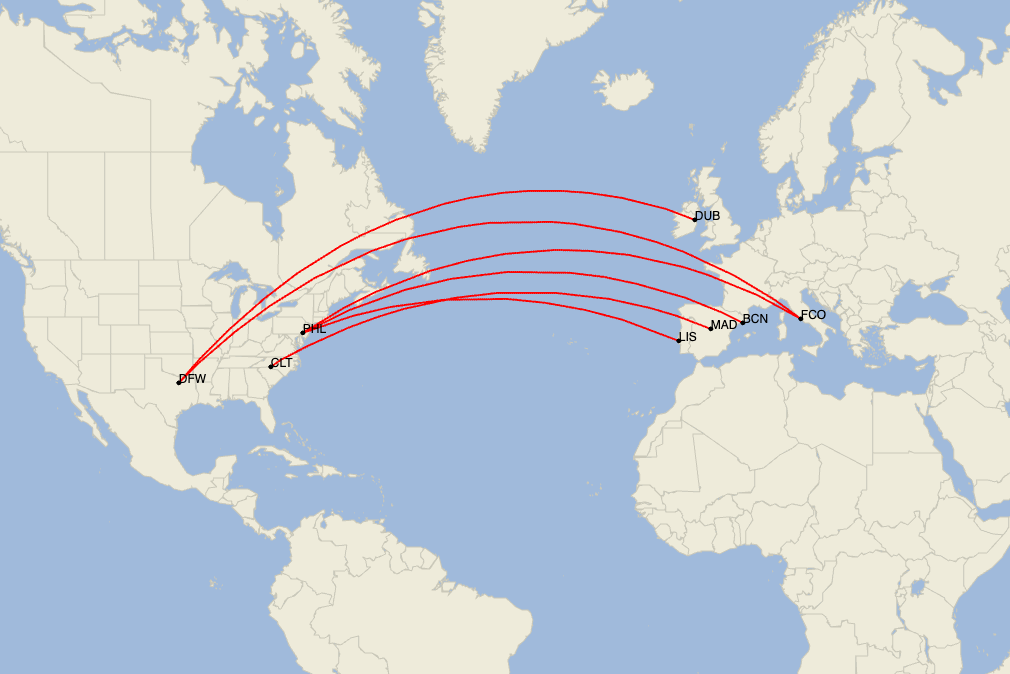
Specifically, the following six routes will now be flown on a year-round basis. Previously, the airline was only planning summer seasonal service in these markets. (Philadelphia to Rome was originally scheduled for less-than-daily service in the winter, but it’ll now be operated each day from October 2023 through March 2024.)
Origin
Destination
Charlotte
Madrid
Dallas/Fort Worth
Dublin
Dallas/Fort Worth
Rome
Philadephia
Barcelona
Philadephia
Rome
Philadephia
Lisbon
Cities like Barcelona, Dublin and Lisbon have long been popular in the summer, but the airline seems to think that will hold up during the winter as well.
That could come from pent-up demand from flyers who couldn’t travel during the pandemic or from those with new flexible work arrangements who can now enjoy the freedom of working remotely from anywhere.
Although Faroese exports to Russia dropped significantly in the spring of 2022, following the Russian invasion of Ukraine in February that year, exports have since climbed back to their pre-February 2022 levels, according to Statistics Faroe Islands.
Thus February of this year saw Faroese exports to Russia of pelagic fish species mackerel, herring and blue whiting amount to 105.4 million DKK (14 mn. EUR), compared to only 58.8 mn. DKK (7.81 mn. EUR) during the same month last year.
In February the exports from the Faroes to Russia of ‘other goods’ amounted to 12.4 mn. DKK (1.65 mn. EUR), which is normal for February. This will usually include fuel to Russian fishing vessels docking in the Faroes.
In November of last year, the Faroes and Russia extended their longstanding bilateral fisheries agreement for another year, and currently the continuation of that arrangement is being debated with differing opinions at the political level.
Prime Minister Aksel V. Johannesen said on April 12th that this is a matter that requires time to thoroughly examine for potential consequences.
The Prime Minister added that the goal is to reach an agreement between all parties represented in parliament.
“We should be speaking with one voice when it comes to foreign relations,” he said.
Overall, Faroese fish exports increased by 2.1 billion DKK (280 mn. EUR) between March 2022 and February 2023, compared to the previous twelve months. The total value of exports for the period amounted to 12.9 bn. DKK (1.71 bn. EUR), with fish products making up 11.8 bn. DKK (1.57 bn. EUR).
Statistics Faroe Islands also noted that total imports for the same period amounted to 12.8 billion DKK, a 3.3-billion increase on the previous 12 months.
20 апр - РИА Новости.Спецпосланник МИД Нидерландов по вопросам бизнеса и восстановления на Украине Рон ван Дартел подал в отставку из-за пророссийских высказываний, сообщило в четверг министерство иностранных дел королевства.
"Специальный посланник по вопросам бизнеса и восстановления Украины Рон ван Дартел уходит в отставку после своих заявлений в книге Жерара Дилессена", - говорится в заявлении МИД Нидерландов.Нидерландский дипломат дал комментарии для книги Дилессена, заявив: "Украинцы - это тоже русские. Мы не должны забывать об этом, такова реальность". Также он говорил о наивности мировых политиков в отношении России.При этом, как заявили в МИД Нидерландов, эти комментарии были сделаны до назначения Рона ван Дартела спецпосланником, а опубликованы только сейчас.



/cdn.vox-cdn.com/uploads/chorus_asset/file/24644228/SGE___Bluetooth_Speakers.png) Image: Google
Image: Google
/cdn.vox-cdn.com/uploads/chorus_asset/file/24644289/SGE___Bryce_Canyon_Image__1_.png) Image: Google
Image: Google
/cdn.vox-cdn.com/uploads/chorus_asset/file/24644230/SGE_Bluetooth_Speakers_v2.jpg) Image: Google
Image: Google
/cdn.vox-cdn.com/uploads/chorus_asset/file/24648189/studio_bot_answers.png) Screenshot: Emma Roth / The Verge
Screenshot: Emma Roth / The Verge


 Взято
Взято 



 Взято
Взято 